

What 1940 Wheat Penny Auction Prices Can Tell You
Updated: Nov 12

Start a 1940 wheat penny value check under the date. An unmarked regular strike is from Philadelphia, D identifies Denver and S identifies San Francisco. The wheat ears tell you the series. The mint, strike type, condition and color determine which sales are worth comparing. This matters even when an auction headline shows exactly the year on your coin.
Original photographs from the MCC collection
Collection example: 1920 Lincoln Wheat Cent. Lincoln faces right, with LIBERTY to the left, IN GOD WE TRUST above and 1920 at the lower right. No D or S is visible below the date. Numerous lines and marks are visible across the surface. Two wheat ears frame ONE CENT and UNITED STATES OF AMERICA, with E PLURIBUS UNUM along the upper rim.


Compare the original specimen photographs with the issue described in this guide. They document design and visible surfaces; they are not a professional grade or confirmation of a rare variety. View the full coin record for specifications and related videos.
Collection example: 1940 Lincoln Wheat Cent. Abraham Lincoln faces right, with LIBERTY to the left, IN GOD WE TRUST above and 1940 at the lower right. No D or S is visible below the date in This photographgraph. Two wheat ears frame ONE CENT and UNITED STATES OF AMERICA, with E PLURIBUS UNUM along the upper rim.
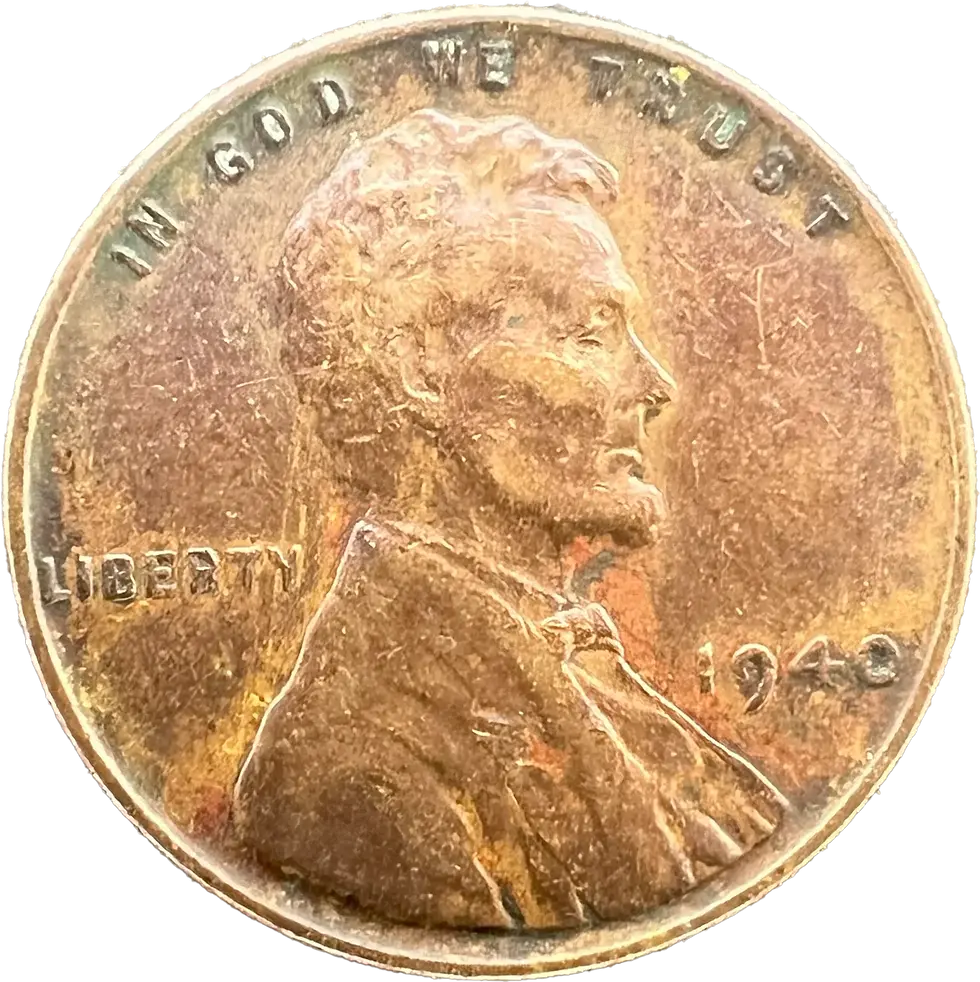

Compare the original specimen photographs with the issue described in this guide. They document design and visible surfaces; they are not a professional grade or confirmation of a rare variety. View the full coin record for specifications and related videos.
Build a comparable group
Read the date, letter and strike type
Use a clear photo of the date area to confirm the mark. PCGS lists the three regular-strike issues separately and has a separate entry for the Philadelphia proof. A shiny coin cannot be identified as a proof from brightness alone. Original packaging or reliable certification can help establish a proof attribution. Compare your photos with MCC’s 1940 Lincoln wheat cent and the labelled images in the PCGS records.
Compare color as well as grade
RD means Red on the grading label. It is a color designation that accompanies the numerical grade. A circulated coin with brown surfaces, a raw piece with patches of color and a certified MS68 RD coin represent different comparison groups. Leave any grade uncertainty visible in your research notes. The MCC guide to RD, RB and BN explains the designations.
Two sales of the same date show why grade matters
The Heritage lot for a Philadelphia 1940 cent graded PCGS MS67+ Red with CAC approval realized $480 on May 9, 2022. PCGS’s auction archive also records $7,500 for a Philadelphia 1940 cent graded PCGS MS68 RD in a Heritage sale in August 2025. Both are historical auction results in U.S. dollars, checked November 7, 2026. Their dates, grades and lot characteristics differ. The results illustrate how sensitive high-grade comparisons can be, and neither sale establishes the price of a raw coin.
Use the amounts as reported by the archives. The buyer’s reported auction total and the consignor’s net proceeds can differ. A current asking price is a seller’s offer, while a realized result records a completed auction. The bronze issue is recorded as 95% copper with the balance tin and zinc. Its metal content is a separate consideration from collectible demand and does not explain either high-grade result.
Frequently asked questions
Is no mint mark a rare error on a 1940 penny?
No mint mark is expected on Philadelphia regular strikes. Check the surfaces and condition before interpreting any listing that uses the absence of a mark as a sales claim.
Can I price a raw 1940 penny from an MS68 RD sale?
Look for sold raw examples of the same mint with comparable detail and surfaces. A top-grade certified sale is useful evidence about a specialized market.
What if I find only listings for sale?
Treat them as asking prices and keep them in a separate column. Try broadening the date range for completed sales while keeping the coin’s mint and approximate condition fixed.
Sources and further reading
Research checked November 7, 2026.


Comments