

PLUS ULTRA on Spain’s Five Pesetas: Read the Eagle, Shield and Pillars
Updated: Nov 12
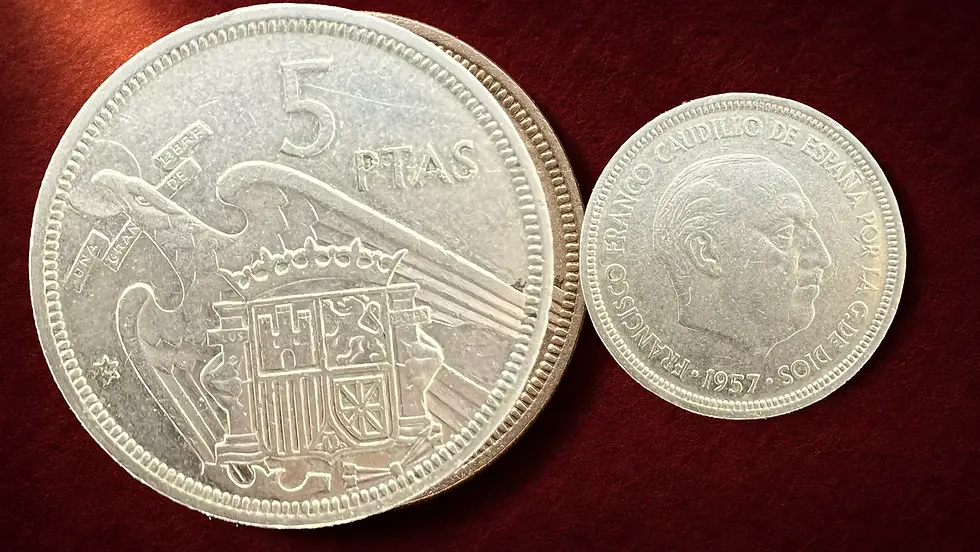
An eagle spreads across the reverse of Spain’s 1957-dated five pesetas. The crowned shield sits below its wings, flanked by pillars bearing the motto PLUS ULTRA. Those features help identify the coin when the portrait inscription is worn. Each feature has a different job in a collector’s description.
Original photographs from the MCC collection
Collection example: 1957 Spain 5 Pesetas · Star 59. Right-facing portrait of Francisco Franco with the main date 1957 below. Spanish coat of arms below 5 PTAS. The small star contains 59, indicating the actual 1959 issue date.


Compare the original specimen photographs with the issue described in this guide. They document design and visible surfaces; they are not a professional grade or confirmation of a rare variety. View the full coin record for specifications and related videos.
Find the value before decoding the symbols
The reverse reads 5 PTAS. Start there to establish five pesetas. Then inspect the crowned shield and the figure behind it. Numista identifies the bird on this type as the Eagle of Saint John and records a yoke and arrows beneath the shield.
The layout is easiest to follow in a full-face photograph. In a small crop, the eagle’s wing can be mistaken for a line of lettering and the pillars can look like isolated bars. Our 1957 Spanish five pesetas with star 59 provides the denomination and heraldic design together.
Read PLUS ULTRA as a motto
PLUS ULTRA is Latin for “further beyond.” On this reverse, it belongs with the pillars flanking the arms. Record it in a legend or design field. The small year digits are in a different position, inside the star to the left.
Use the words that remain legible rather than filling in what you expect to see. If only ULTRA is visible in a photo, note that partial reading and compare it with the documented design. The complete motto can help you locate a reference, while the denomination, portrait and date establish the candidate type.
Use the law and catalogue for different questions
Spain’s law of December 26, 1957 authorized five-, twenty-five- and fifty-peseta coinage. It describes the national arms and value on the reverse. That primary document establishes the design program. The coin reference adds the details a collector needs to match a particular piece.
Numista lists this five-peseta type as copper-nickel, 75% copper and 25% nickel, with a nominal weight of 5.75 grams and diameter of 23 millimeters. The catalogued 1957 piece with 59 in the star corresponds to the 1959 issue. Our guide to coins with two dates explains why those two numbers belong in separate fields.
Describe your piece in a useful order
Write Spain, five pesetas, 1957, then the star digits if you can read them. Add the portrait and the reverse motifs as supporting details. Keep a close-up of the star next to the full reverse so a second reader can place the tiny feature on the actual design.
If a star is worn flat or partly filled in the photograph, record the digits as unreadable. A search for an attractive rarity should start after identification. Compare completed results with the same star and comparable condition, keeping single coins separate from mixed lots or certified exceptions.
The MCC video about the five-peseta coin offers another look at the collection piece.
Frequently asked questions
Does PLUS ULTRA tell me the date or denomination?
It is a motto. Look for 5 PTAS for the denomination and inspect the portrait date and small star separately.
What is the eagle on the 1957 five pesetas?
The type reference identifies it as the Eagle of Saint John. It appears behind the crowned Spanish arms.
Is the silver color evidence of silver?
The documented circulation type is copper-nickel. Use the exact coin reference and physical observations when checking a specimen.
Sources and further reading
Research checked November 6, 2026.


Comments